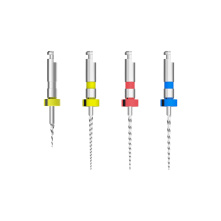
Wo kann ich WAMkey kaufen?
Sie können Ihre Bestellung auf unserer Website direkt online aufgeben. Sie bekommen Ihre Instrumente direkt geliefert oder über unseren Händler in Ihrer Region. Sehen Sie sich auchg die Liste unserer Händler in Ihrer Region an.
Welche Vorteile hat der Kronenabnahmeschlüssel im Vergleich zu herkömmlichen Instrumenten, mit denen die Ränder einer vertikalen Öffnung (vom zervikalen Rand bis zur Okklusalfläche) gedehnt werden oder die Krone in T-Form geöffnet wird?
Die Kronenentferner haben einen doppelten Vorteil: Sie sind beim Bohren zeitsparend (also weniger Bohrerverschleiss) und verändern nicht den zervikalen Kronenrand. Sie können also die Kronen eventuell sofort als Provisorium oder definitiv wiederverwenden.Im Übrigen sind die Abnahmeschlüssel weitaus weniger traumatisierend, da auf die anliegenden Pfeiler seitlich kein Druck ausgeübt wird, der durch die Spreizung einer vertikalen Öffnung entstehen kann. Die Arbeit wird mit sanft und nicht mit Kraft durchgeführt;
Wenn ich den Abnahmeschlüssel verwende, muss ich ein Loch in die Krone bohren. Ich kann sie also nicht mehr wiederverwenden?
Doch. Der Kronenabnahmeschlüssel hat aber vor allem folgende Vorteile:
1. Zeitgewinn durch schnelle Entfernung
2. Systematische Erhaltung der Stützpfeiler
3. Zeitgewinn durch die provisorische Wiederverwendung des Zahnersatzes
Hinsichtlich einer langfristigen Wiederverwendung ist zu bemerken, dass viel Zahnärzte bereits unser Gerät benutzen und die Krone dauerhaft wiederverwenden. Der Erfolg ist schnell erklärt: der reparierte Zahnersatz erfüllt weiterhin alle wesentlichen Funktionen:
- Okklusion
- Kontakt mit den benachbarten Zähnen
- Dichtigkeit
- Ästhetik
Wesentliche Teile wie Kontaktpunkte, Kronenrand und Okklusalfläche werden nicht beeinträchtigt. In den meisten Fällen genügt eine einfache Reparatur, die zumeist direkt nach dem Ausbau erfolgen kann (je nach Fall mit Composite oder Amalgam). Der Patient entscheidet über das kosmetische Reparaturergebnis, wie er sich auch für eine Metall- oder VMK-Krone entscheidet.
Kann ich WAMKey (R) bei VMK-Kronen verwenden?
Natürlich. Die Kronenabnahmeschlüssel verursachen nur eine geringe Spannung und in 70 bis 80% der Fälle können Sie Keramikkronen ohne Zersplitterung erhalten. Die Erfolgschancen hängen hauptsächlich von der Einhaltung des Gebrauchsprotokolls ab, das Sie mit den Instrumenten bekommen, und von einem kleinen Handgriff, den Sie nach ein paar Einsätzen schnell beherrschen.
Here are some usefull advices in Shakespeare's language: https://www.youtube.com/watch?v=7r4OAqOIaH4
Gibt es auf WAMkey Garantie?
Ja. Für Ihre Instrumente ist die Einhaltung des Genrauchsprotokolls ein erste Garantie. Wenn Sie das Protokoll einhalten, ist die zum Entfernen des Zahnersatzes notwendige Kraft so gering, dass eine Beschädigung der Instrumente praktisch ausgeschlossen ist. Im Übrigen gilt für die Instrumente die allgemein übliche Garantie, sofern sie sachgemäß nach dem Gebrauchsprotokoll eingesetzt werden.
Warum braucht man 3 Kronenabnahmeschlüssel?
Die nebenstehenden Bilder zeigen, dass mit dem kleinsten Instrument ein Kraftmoment erzielt wird, das nah an der Achsrichtung des Zahns liegt. Das Instrument übt also am wenigsten Spannung auf den Zahn und den Zahnersatz aus (auf Bild 2 befinden sich die Kräfte quasi in Achsrichtung, auf Bild 1 sind die Kräfte weit von der Achse entfernt und verursachen eine Kippbewegung).
Man kann also unter den bestmöglichen Bedingungen den Zahnersatz entfernen (Erhaltung der Präparation und des Zahnersatzes, Komfort für den Patienten). Das Protokoll schreibt demnach seine Verwendung prioritär vor, da in 50% der Fälle mit diesem Instrument der Zahnersatz entfernt werden kann.
In den anderen Fällen (sehr eng oder fest sitzende Krone, Metallstiftaufbau, zu große Kavität, große Furche an der Okklusalfläche, dicke Zementschicht, sodass der Schlüssel leer dreht...) bietet sich automatisch die Verwendung größerer Instrumente an. Ursprünglich sollte ein Instrument mit 3 austauschbaren Aufsätzen angeboten werden, aber eine Umfrage bei "Test"-Zahnärzten hat gezeigt, dass sie mehrheitlich lieber mit je einem Griff pro Spitze arbeiten. Einzelne Instrumente können jederzeit nachgekauft werden

Does WAMkey work with all kind of cements and resin cements?
As most dental devices, WAMkey can't guarantee a 100% success. But practionners using the WAMkey usually report an over 90% success rate. In 2012, an evaluation conducted by Dental Advisor in USA resulted in a 92% success rate over 320 crowns. And for sure, some of the 92% crowns removed with WAMkey were bonded and not cemented.
WAMkey applys a couple of forces at the right spot (between the 2 elements we want to separate) in the right direction (along the axis of the prep). So we can assert that if you fail in removing a crown with WAMkey, there's absolutely no chance to remove it without destroying it completely.
Does WAMkey work on Zirconia crowns?
1/ WAMkey is presently the only device on the market that applies the energy in the right place (in the middle of the occlusal side of the preparation, between the preparation and the framework) and in the right direction (along the grand axis of the preparation). So if WAMkey doesn't allow you to remove a crown, no other device will allow you to succeed without destroying the crown. So WAMkey is presently you best chance to succeed.
2/ Zirconia raises 2 essential difficulties:
-Drilling in Zirconia is harder than in most other material used for crowns. But specific burs allow now to achieve this in better conditions than conventional diamond burs. We offer you to try Zircator that is perfectly adapted to the process of WAMkey:
http://www.wamkey.com/FR/produit/253-/.
With Zircator, you should be able to create the appropriate tunnel between the preparation and the framework, which gives you a big chance to succeed.
- Some cements and bonding devices are more resistant than others, which can complicate your task. This doesn't mean that it will make it impossible. Many practitioners mention that they succeeded in removing Zirconia crowns. Haven't you ever faced a patient who had his crown loosened on its own while bonded with a highly resistant resin cement?
3/ Several serious studies reveal that all in all, WAMKey is successful in approximately 90%, provided that it's used in good indications (not on the lower anterior teeth, and preferably on premolars and molars).
In conclusion, it is really worth trying. The success rate is probably lower on Zirconia crowns than metal crowns, but far from zero. And each time it will work, you'll save your time, your burs, you'll preserve your handpiece and you'll be able to reuse the crown as a temporary or as a permanent.
Is there any risk to use WAMkey on vital teeth?
This objection is legitimate.
This question concerns young patients rather than old ones, because the older the patient is, the smaller and the lower the pulp is.
In most cases, Don't forget that:
- before creating the tunnel, you will have to enlarge the window into the crown until you can see the cement level
- Once you can see the cement, and only once you can see it, you create the tunnel.
- When drilling the tunnel, you use the crown as a guide (much harder than the dentine), so there is insignificant chance to drill into the pulp.
There is however one important recommendation (see advices into the instruction CDrom). Add some water with the syringe in order to cool the bur when creating the tunnel, because the spray of the hand-piece will not be able to enter into the tunnel.